
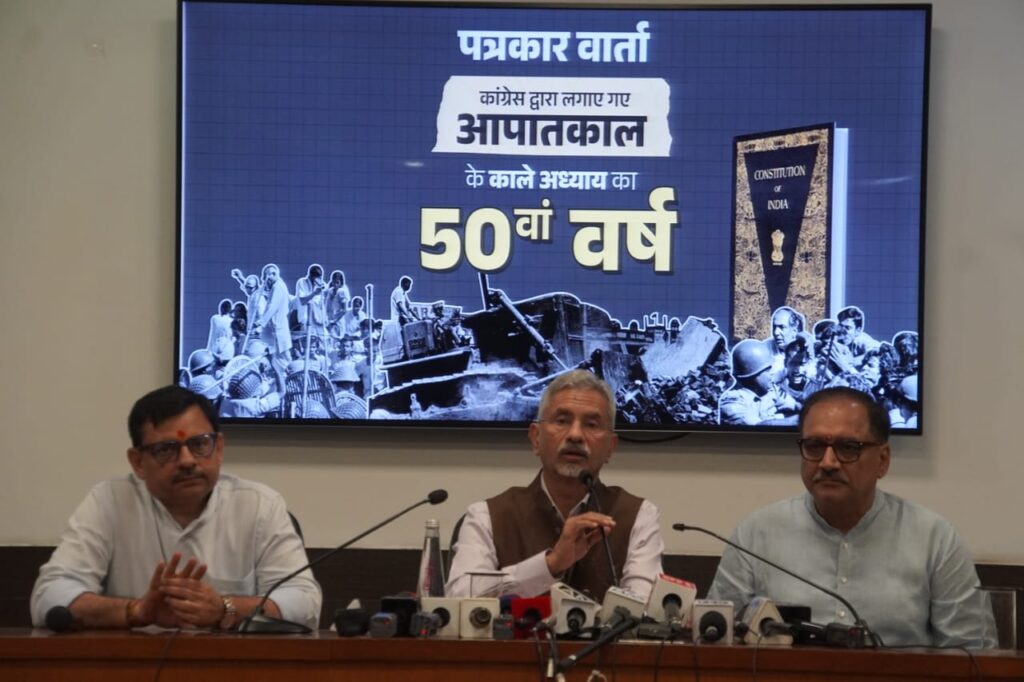
To mark the 50th anniversary of the Emergency imposed in 1975, the Delhi unit of the Bharatiya Janata Yuva Morcha (BJYM) organized a Mock Parliament on 27 June at the NDMC Convention Centre. The event, themed around the erosion of democratic rights during the Emergency, witnessed participation from students of various Delhi colleges. Union External Affairs Minister S. Jaishankar and Delhi BJP President Virendra Sachdeva were present as chief guests, along with Delhi BJYM President Sagar Tyagi. The programme began with a ceremonial lamp lighting and a special exhibition showcasing the events and impacts of the Emergency. In his welcome speech, Sagar Tyagi described the Emergency as a dark chapter in India’s democratic journey and emphasized the importance of educating today’s youth about the dangers of authoritarianism. Virendra Sachdeva said the Emergency was a time when the Constitution was strangled to help one family retain power. He noted that people were jailed without cause and some even lost their lives. He urged youth to come out of mobile addiction and serve the nation with sincerity.
S. Jaishankar, in his address, stressed that the Emergency was not just a political crisis but a direct attack on India’s way of life and civil liberties. He pointed out that key constitutional amendments during that period the 38th, 39th, and 42nd were aimed at silencing the judiciary and removing fundamental rights. He criticized Congress for never apologizing for the Emergency, adding that even if someone’s life was in danger, courts had no power to intervene at that time. He remarked that slogans like “Indira is India, and India is Indira” showed how the nation was equated with a single individual. He recounted the widespread fear created through police raids and arrests, saying people had no idea when they would be freed. He also mentioned that due to a bilateral agreement signed with Sri Lanka during the Emergency, India lost its traditional fishing rights an issue that continues to affect Indian fishermen.
Listing six key lessons from the Emergency, S. Jaishankar said democracy is in India’s DNA and the 1977 elections were a result of people rejecting dictatorship. He warned that placing family above the nation weakens democracy and that Indians must be cautious of those who criticize the country abroad. Empowering citizens, he said, is essential to prevent future authoritarianism. He also underlined the importance of national pride, citing the example of Operation Sindoor, after which Indian leaders across party lines projected a strong image abroad. Lastly, he said that the Emergency should not be seen as just a historical event because even today, many of its architects and supporters have shown no regret. The Mock Parliament concluded with a clear message to the youth: protecting democracy requires not just awareness but active participation and moral courage.
