
- Party announces 45-day nationwide ‘MGNREGA Bachao Sangram’
- Reaffirms demand for restoration
- Right to work converted into govt discretion: KC Venugopal
- Only guarantee in new law is dangerous centralisation: Ramesh
NEW DELHI, January 3: The Congress today blew the bugle for a decisive battle to get the Mahatma Gandhi National Rural Employment Guarantee Act (MGNREGA) restored.
The party announced the launch of the ‘MGNREGA Bachao Sangram’ from January 10, which will continue till February 25.
The party reiterated its demand for withdrawal of the VB–GRAM–G Act, restoration of MGNREGA in its original form, and protection of the people’s Right to Work and Panchayati Raj institutions.
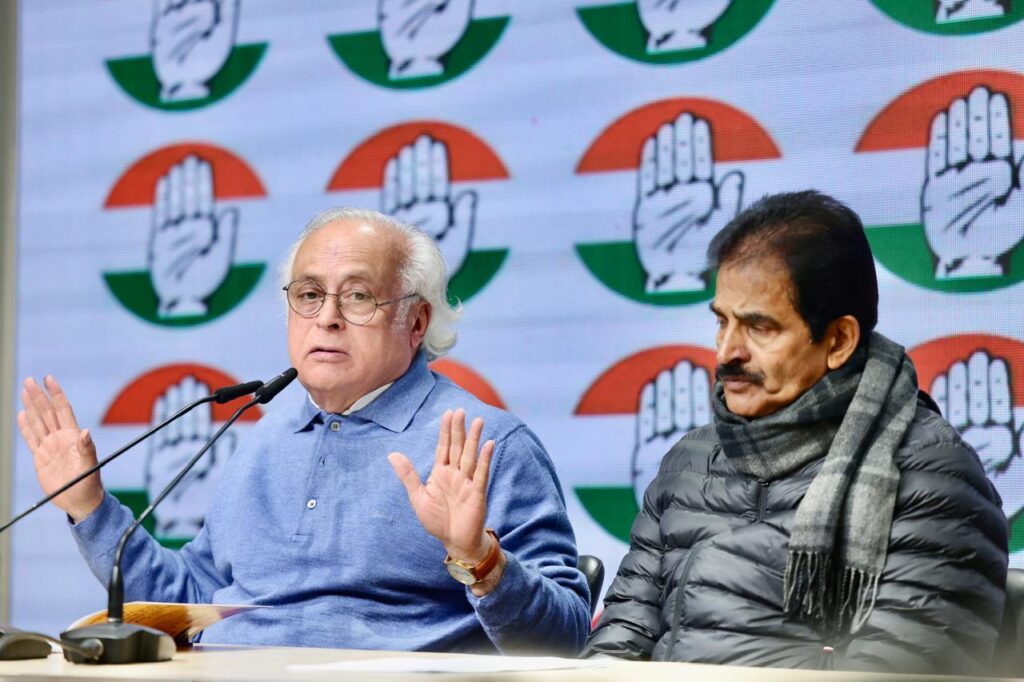
Addressing a press conference at the AICC headquarters here, Congress general secretary (organisation) K.C. Venugopal and general secretary (communications) Jairam Ramesh outlined the one-and-a-half-month-long nationwide agitational programme.
Venugopal said the VB–GRAM–G framework fundamentally dismantles MGNREGA by converting a statutory Right to Work into a discretionary, centrally controlled programme. He pointed out that the new framework replaces a demand-driven, rights-based law with a budget-capped scheme, where employment will be available only in centrally notified Panchayats, leaving millions of rural households without legal entitlement to work. He noted that MGNREGA, enacted in 2005, guaranteed employment within 15 days or compensation, provided inflation-linked wages, and functioned as India’s most effective rural safety net during droughts, floods, economic downturns and the COVID-19 pandemic. He said the new framework negates these core guarantees.
Venugopal said VB–GRAM–G introduces “normative allocations”, meaning work will stop once funds are exhausted, irrespective of rural distress, thereby silently extinguishing the legal enforceability of employment under MGNREGA.
Raising concerns over centralisation, the senior Congress leader said planning powers earlier vested in Gram Sabhas and Panchayats would now rest with the Centre, undermining the 73rd Constitutional Amendment. “Many Panchayats may receive no funds at all, reducing elected local bodies to mere implementing agencies,” he warned. He also referred to the provision of a 60-day work blackout during peak agricultural seasons, arguing that it would weaken labour’s bargaining power, suppress wages and disproportionately harm women and landless labourers. On wages, he said VB–GRAM–G removes the certainty of notified, inflation-linked wage rates, allowing the Centre to fix Panchayat-specific wages, which could lead to underpayment and income suppression.
Venugopal expressed concern over the inability of states to provide 40 per cent matching grants. He said the Centre is shifting financial responsibility to states, paying only 60 per cent of wages compared to 100 per cent earlier. This, he added, would force poorer states to either deny work or divert funds from health, education and welfare.
Expressing concern over technology-driven exclusion, he said biometric attendance, geo-tagging and app-based monitoring could deny wages to workers with worn fingerprints, poor connectivity or low digital literacy, reversing transparency gains achieved through public muster rolls.
Dismissing government claims of 125 days of guaranteed work as misleading, Venugopal said reduced Central funding would, in practice, lead to fewer workdays.
Venugopal warned that the changes would result in rising rural unemployment, wage suppression, increased distress migration, a decline in women’s participation, and a disproportionate impact on Dalit and Adivasi households, weakening village economies. He also termed the removal of Mahatma Gandhi’s name from the scheme a condemnable act, saying that Gandhi ji represented the dignity of labour, village self-rule, and the moral responsibility of the State; erasing his name reflects an attempt to erase the rights-based vision behind MGNREGA itself.
Detailing the nationwide programme from January 10 to February 25, Venugopal said district-level press conferences, one-day fasts, Panchayat chaupals, sit-ins, dharnas at district offices, Vidhan Sabha gheraos and zonal AICC rallies would be organised.
He said PCC-level preparatory meetings would be held on January 8. District-level press conferences would take place on January 10, followed by a one-day fast on January 11 near statues of Mahatma Gandhi or Dr B.R. Ambedkar. From January 12 to 29, Panchayat-level chaupals and mass outreach programmes would be conducted. During this phase, letters from Congress President Mallikarjun Kharge and Leader of Opposition Rahul Gandhi would be personally delivered to Gram Pradhans, former Gram Pradhans, Rozgar Sevaks and MGNREGA workers.
On January 30, Martyrs’ Day, peaceful sit-ins would be organised at ward and block levels. From January 31 to February 6, district-level ‘MGNREGA Bachao’ dharnas would be held.
From February 7 to 15, state-level gheraos would be organised in front of Vidhan Sabhas, Raj Bhawans or other Central government offices.
The Sangram will culminate with four zonal mega rallies between February 16 and 25.
Speaking on the occasion, Jairam Ramesh said the only guarantee in the new law was the guarantee of “dangerous centralisation”.
“There is no guarantee of employment and no guarantee of financial assistance to states. The only guarantee is that the Central government will decide how to allocate funds and to whom,” he said.
On changing the fund allocation ratio from 90:10 to 60:40, Ramesh said it violated Article 258, which requires such decisions to be mutually acceptable to the Centre and the states. He said no consultations were held with the states.
Jairam Ramesh said the new act would meet the same fate as the three controversial farm laws. However, he added, while the anti-farm law agitation was Delhi-centric, the MGNREGA Bachao Sangram would be carried out at the panchayat, block, district, and state levels.
